

Current understanding of the pathogenesis of type 2 diabetes mellitus (T2DM) requires moving away from monotherapy as a universal approach. The progressive deterioration of beta-cell function, the growth of insulin resistance, and the difficulty of compensating for glycemia dictate the need for combination therapy — with drugs that affect different mechanisms of blood sugar regulation. In this coordinate system, Dorzagliatin-the first next-generation glucokinase activator-has established itself as a powerful and versatile partner in combination regimens.
Why Dorzagliatin is the Perfect ingredient for Combinations
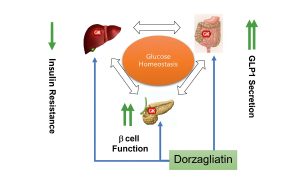
The uniqueness of Dorzagliatin lies in its bidirectional action: it simultaneously activates glucokinase in the beta cells of the pancreas and in the liver. This means that the drug:
- increases the physiological secretion of insulin with increased glucose;
- reduces glucose production by the liver;
- does not cause hypoglycemia due to the dependence of the effect on the sugar level;
- improves beta-cell function and reduces insulin resistance.
These characteristics make Dorzagliatin a powerful base for combining with other classes of hypoglycemic agents-from metformin to DPP-4 and SGLT2 inhibitors.
Combination with metformin: enhancing basic therapy
Metformin remains a first-line treatment for T2DM due to its ability to inhibit liver gluconeogenesis and increase insulin sensitivity. However, with a decrease in the functionality of beta cells, its effect is limited.
SEED and DAWN clinical trials have shown that adding Dorzagliatine to metformin therapy significantly improves glycemic control:
- In the DAWN study, after 24 weeks of therapy, the HbA1c level in the Dorsagliatin + metformin group decreased by 1.02%, compared to 0.66% in the metformin monotherapy group;
- In 44.4% of patients, the target level of HbA1c <7 was achieved%;
- Improvement of beta-cell function was accompanied by a decrease in insulin resistance (HOMA2-IR);
- The safety profile remained stable: hypoglycemia <1%, no dosage adjustment was required.
These results confirm that the combination of Dorsagliatine + metformin is a synergistic interaction that can affect both the hepatic and insulin mechanisms of glucose regulation.
Combination with DPP-4 inhibitors: double control of insulin secretion
DPP-4 inhibitors (such as sitagliptin) work through the incretin mechanism, increasing insulin secretion and suppressing glucagon. Their combination with Dorzagliatine allows you to combine:
- stimulation of physiological insulin response via incretins (DPP-4);
- direct activation of glucose-dependent secretion via glucokinase (Dorzagliatin).
The results of pharmacodynamic studies showed:
- No clinically significant drug interaction: PK parameters of both drugs do not change;
- The combination of Dorzagliatin + sitagliptin provides a greater reduction in postprandial glycemia (glucose iAUC) and a better C-peptide response.;
- Safety is maintained at a high level — without increasing the frequency of hypoglycemia or serious side effects.
This combination is particularly promising for patients with severe postprandial hyperglycemia and reduced beta-cell function.
Combination with SGLT2 inhibitors: for comprehensive control
Interest in the combination of Dorzagliatine with sodium-glucose cotransporter type 2 (SGLT2) inhibitors is due to their multidirectional mechanisms:
- SGLT2 inhibitors remove glucose in the urine, helping to reduce weight, blood pressure and reduce the glycemic load.;
- Dorzagliatine regulates glucose production and insulin resistance.
Studies of the combination with empagliflozin show:
- The decrease in glucose was more pronouncedthan with monotherapy with any of the drugs.;
- Increased insulin secretion (C-peptide growth)was observed;
- A good safety profile, without increasing the incidence of urinary tract infections or dehydration.
The combination may be an optimal strategy for patients with obesity, cardiovascular risks, or restrictions in the use of other classes of drugs.
Clinical significance and recommendations
For the doctor, Dorzagliatin opens up the possibility of personalized combination therapy. It can be used:
- with insufficient control on metformin;
- to enhance incretin therapy (DPP-4);
- as part of a complex scheme with SGLT2 in metabolic syndrome and obesity;
- in patients at risk of hypoglycemia, where insulin or sulfonylureas are undesirable.
It is important to emphasize that Dorzagliatin does not require dose adjustment of other drugs and can be integrated into therapy without changing the usual regimens.
Combinations with Dorzagliatin open a new era in the treatment of T2DM. It not only enhances the hypoglycemic effect of basic drugs, but also affects the fundamental mechanisms of diabetes pathogenesis — beta-cell function, gluconeogenesis, and insulin sensitivity.
Stability, safety, flexibility, and proven efficacy make Dorzagliatin a key element in modern personalized therapy strategies. This is not just a supplement to treatment — it is a qualitative enhancement that allows you to go beyond the standard approach and get closer to controlling the disease at the pathogenetic level.
Sources:
https://www.nature.com
https://pubmed.ncbi.nlm.nih.gov
https://diabetesjournals.org